
The images we show contribute to building our representation of marriage.
When looking at websites, magazines or social media dedicated to marriage, certain stories appear much more often than others.
The couples represented are still frequently young, able-bodied and heterosexual. Certain body types, skin colours, sexual orientations, situations of disability or simply certain ages remain much less visible.
For a wedding photographer or videographer, this question is not completely abstract.
It directly concerns the images we produce and those we then choose to show.
And it is a question I ask myself more today in my own work.
Showing more of the reality of weddings.
The weddings we film do not correspond to a single model.
Two women are getting married.
Two men are getting married.
People are getting married at 25, 40 or 60 years old.
Some couples or some of their loved ones live with a disability.
Family stories, cultures, bodies and journeys are different.
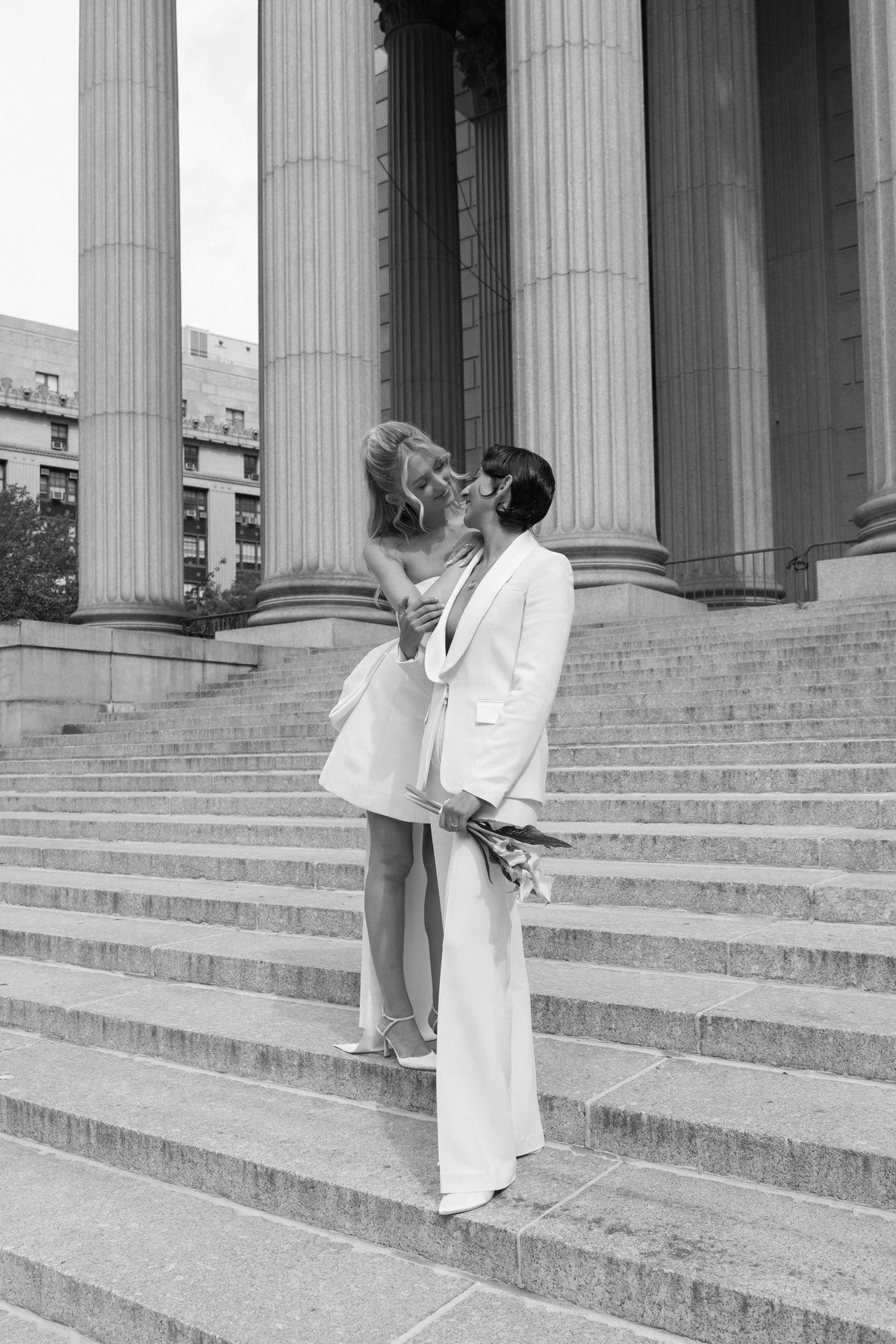
None of this should be exceptional in the way we represent marriage.
And yet, when some people are looking for a photographer, a videographer or simply inspiration, they may still struggle to find themselves in the images that are offered to them.
Rethink my own perspective as well.
I can hardly write about this topic without also looking at my own work.
For a long time, I probably reproduced certain codes of the wedding universe without really questioning them.
Not out of a desire to exclude.
Simply because one easily ends up reproducing the images one sees around them: the same references, certain ways of representing a couple, certain ideas of what would be photogenic or what would correspond to the aesthetics of a wedding.
Over time, my perspective has evolved.
Today, when I look at my portfolio or think about the images I want to show, I also ask myself this question:
can enough people recognise themselves in what I show of weddings?
I find this question much more interesting than a desire to "appear inclusive".
→ Discovering my way of filming a wedding
Inclusivity is not an aesthetic.
This is probably the point that seems most important to me.
I do not wish to "diversify" my portfolio as one would seek to fill different categories.
A person in a wheelchair is not a subject.
A couple of women is not a concept.
A 45-year-old bride is not an exception that should be staged differently.
They are simply people getting married.
And my work remains exactly the same: to understand the people I have in front of me, observe what happens between them, and build a film from what is actually present.
The gaze can be attentive to differences without making those differences the subject of the film.
Filming people before filming an image of the wedding
This reflection ultimately quite directly aligns with my way of working.
I am increasingly seeking not to match a wedding to a predefined image.
I prefer to start with the people.
From their way of being together.
From their loved ones.
From their gestures.
From their voices.
From their energy.
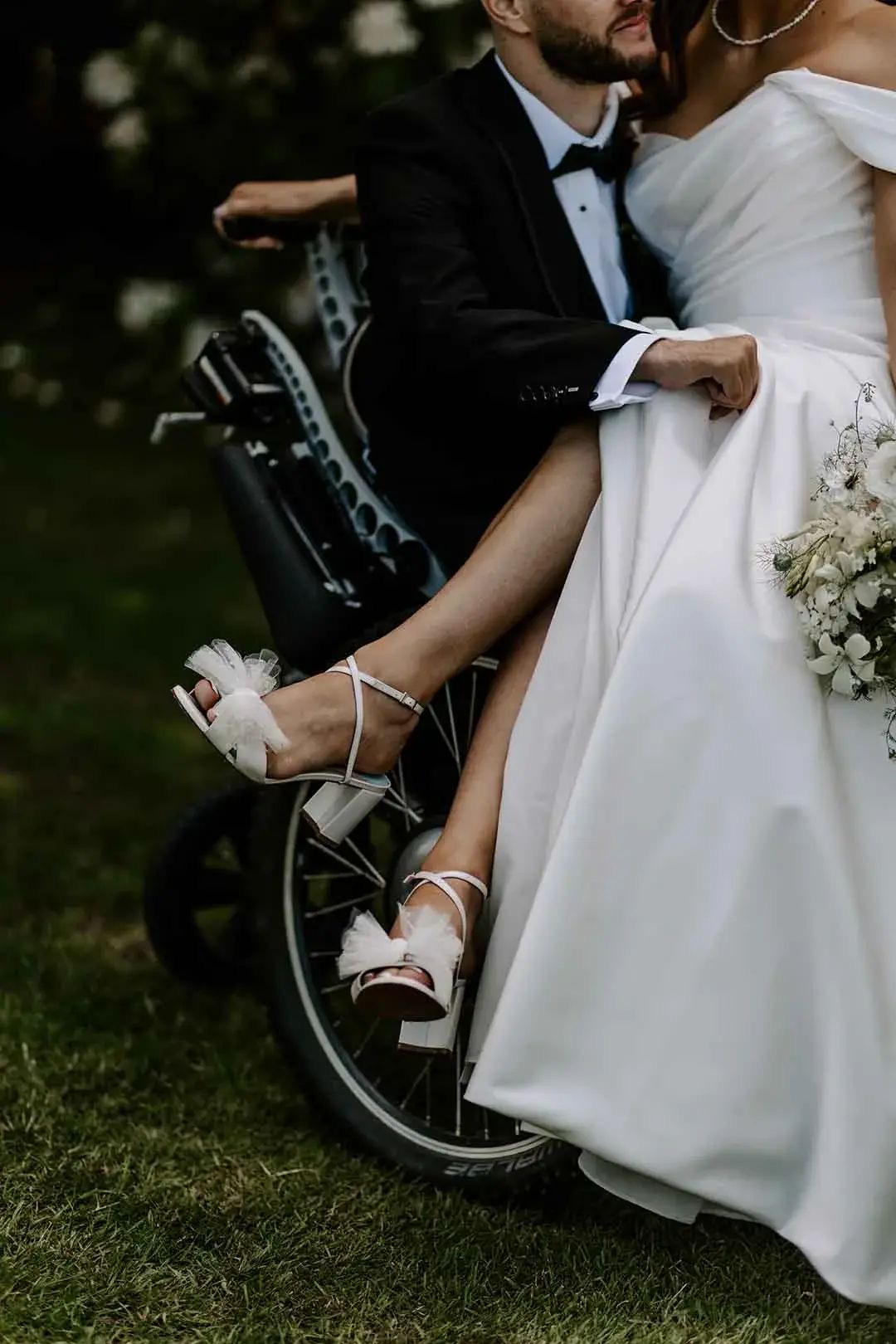
This also means accepting that a wedding can be elegant without conforming to the images usually associated with luxury.
That a couple can be very different from the one we filmed the previous week.
That a story does not need to fit into a category to be interesting to tell.
This diversity particularly interests me because it gives each film its own substance.
A high-end image does not need to be uniform.
There is also an aesthetic question behind this reflection.
The world of high-end weddings has its codes: certain venues, certain silhouettes, certain colours, certain editorial references.
I personally like a precise, elegant, crafted image.
But elegance and uniformity are not synonymous.
A beautiful light remains a beautiful light.
A precise frame remains a precise frame.
A consistent colourimetry remains essential.
The quality of an image does not depend on the age, body, skin colour, gender or sexual orientation of the people in it.
It depends on the perspective we have on them and the way we film them.
This is a distinction that matters a lot in the direction I wish to give to my work.
To represent without transforming people into symbols.
There is also an opposite pitfall.
In wanting to better represent certain realities, one can end up reducing a person to what one precisely wishes to make visible.
I do not want a couple to become "the LGBTQ+ couple in my portfolio."
No more than a person with a disability should become a demonstration of my inclusivity.
If I share a wedding, I want to talk about the people, the place, what happened, their story or the energy of that day.
Exactly like for any other wedding.
Representation probably becomes more accurate when it stops needing to signal itself.
Different films because people are.
This reflection ultimately aligns with a fairly simple conviction.
I do not want the people I film to have to correspond to my portfolio.
I prefer my portfolio to expand as I meet new people.
This requires being attentive to one's own habits and sometimes questioning certain references.
But this is also what makes this profession interesting.
Every wedding brings a different material.
Every couple has their own way of being together.
And every film should be able to preserve this uniqueness without trying to fit it into a pre-written model.
Continue to broaden the perspective.
I do not consider this reflection to be finished.
It will probably continue to evolve with the weddings I film, the people I meet, and the images I choose to show.
I do not want to make it a statement of principle.
Rather, it is an additional attention in my way of working.
Continue to look.
Continue to question certain habits.
And ensure that the elegance, emotion, or beauty that I seek in my films can belong to many more stories.
Because there is not just one way to love, to marry, or to be beautiful in an image.
You can discover my wedding films or contact me to talk to me about your project.