A wedding day can last ten, twelve, sometimes fifteen hours.
So when a videographer announces a film of 5, 6 or 7 minutes, the question is quite natural:
How can you tell an entire day in so little time?
Yet, part of contemporary wedding films has gradually moved away from chronological reporting towards a tighter, more narrative and sometimes more creative writing.
What has changed is therefore not just the duration.
It’s the way of telling.
A shorter film does not necessarily seek to show less. It often seeks to select more, to bring moments closer together, to use voices and sounds differently and to give each image a true function in the narrative.
A Wedding Film No Longer Needs to Show Everything
For a long time, a fairly natural way to construct a wedding film was to follow the course of the day:
the preparations, the ceremony, the cocktail, the dinner, the first dance, then the evening.
This chronology remains perfectly suited to certain films and certain expectations.
But it is no longer the only way to tell a wedding.
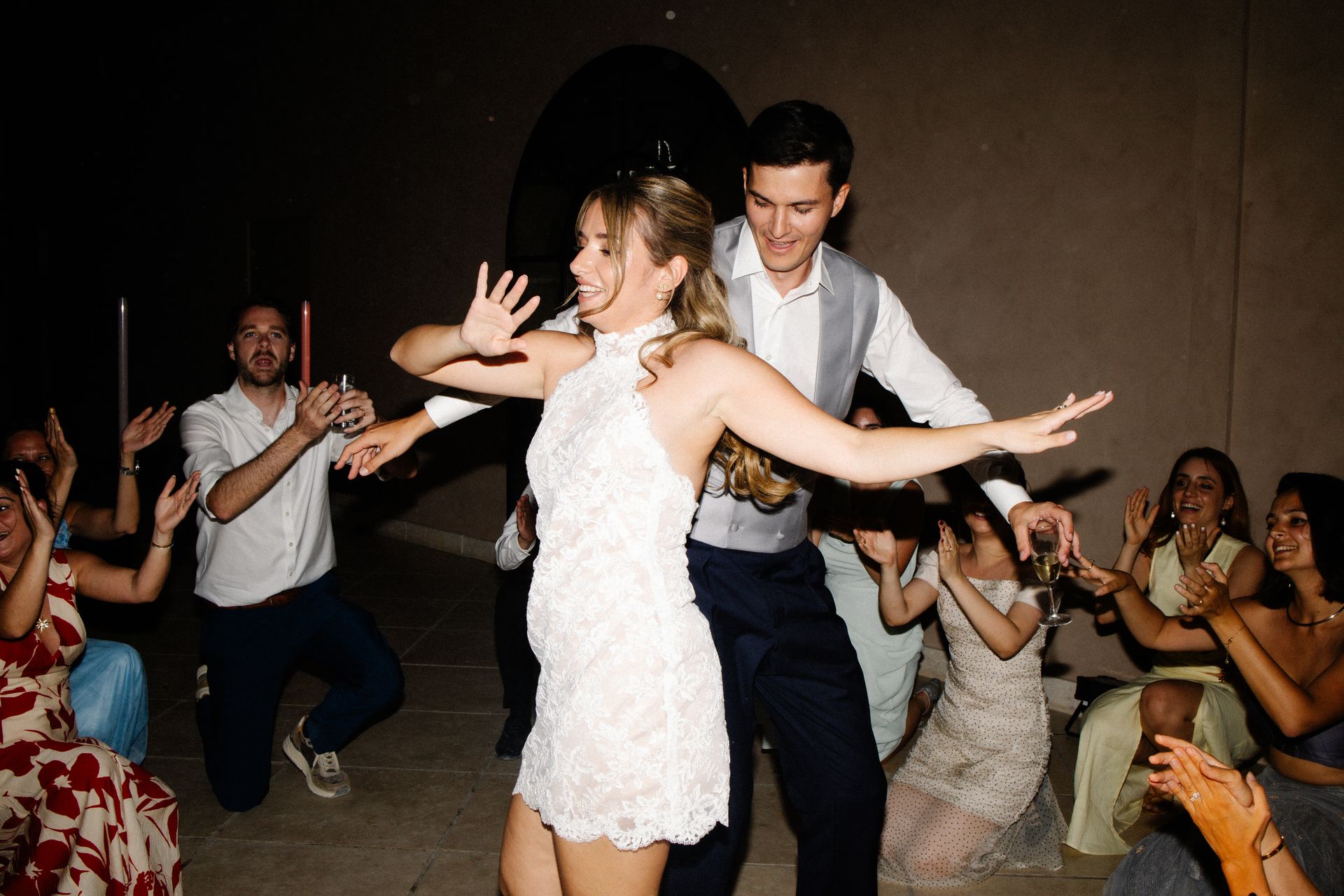
A film can today start with a few seconds of celebration, return to the calm of the preparations, use a phrase spoken during a speech several hours later, and then go back to the ceremony.
The day remains the raw material.
But its chronology is no longer necessarily that of the film.
Telling does not mean showing everything.
It is probably the most important change.
To understand a scene, we do not always need to see it in its entirety.
A few seconds may be enough.
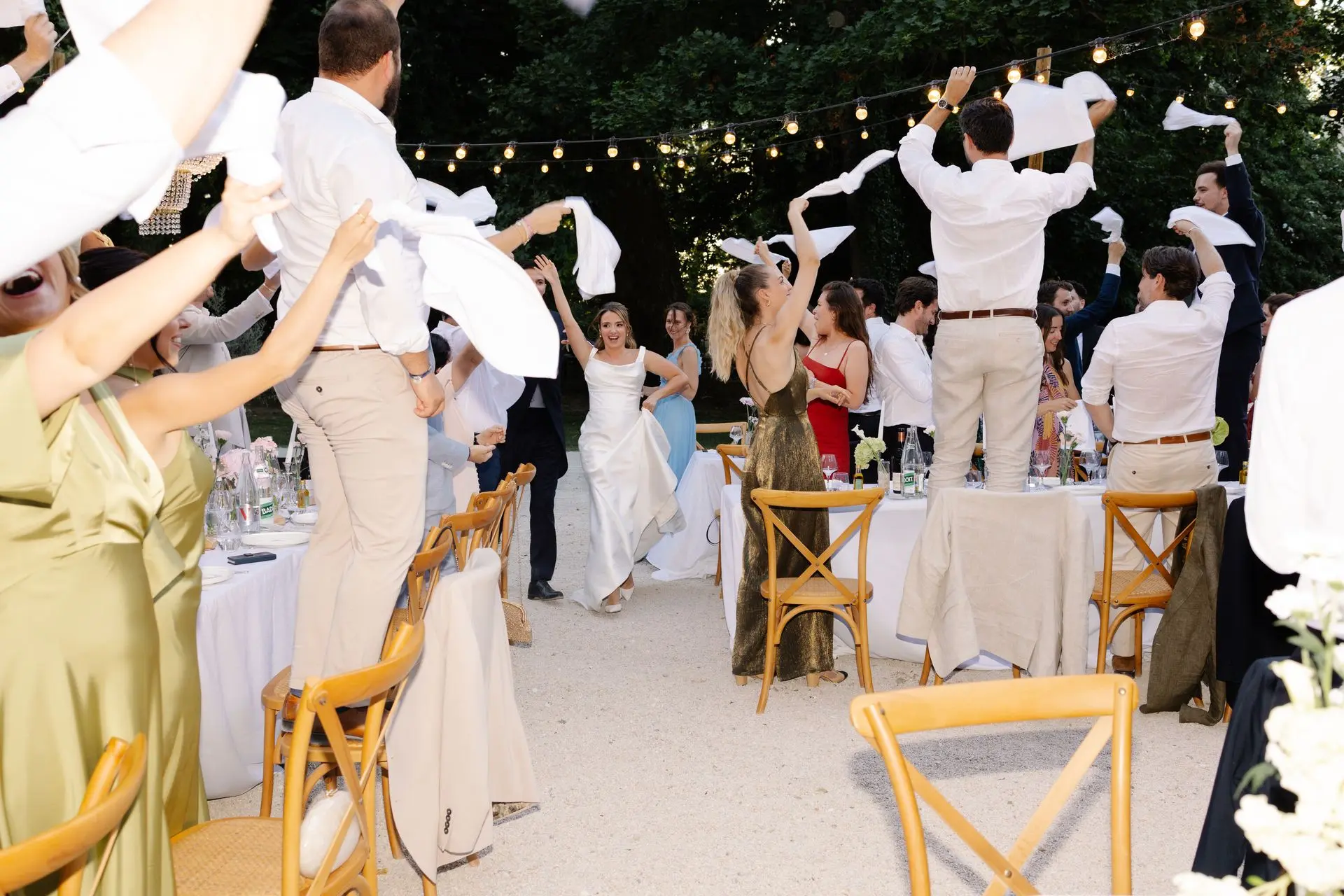
A hand that trembles slightly during the preparations. A father discovering his daughter. A glance exchanged during the ceremony. A burst of laughter in the middle of a speech. A few seconds of silence before an entrance.
Taken separately, these are fragments.
But when they are chosen and assembled, they allow for a much deeper understanding than what they literally show.
This is the principle of ellipsis: to give the viewer the opportunity to understand what exists between two images without needing to show everything.
The film then becomes denser.
Not because it necessarily goes faster, but because each sequence can contain more information.
Chronology becomes a material rather than a constraint.
This also allows for much more creativity in editing.
A phrase spoken at 8 PM can accompany images shot at 2 PM.
A parent's words can be associated with a sequence of the couple.
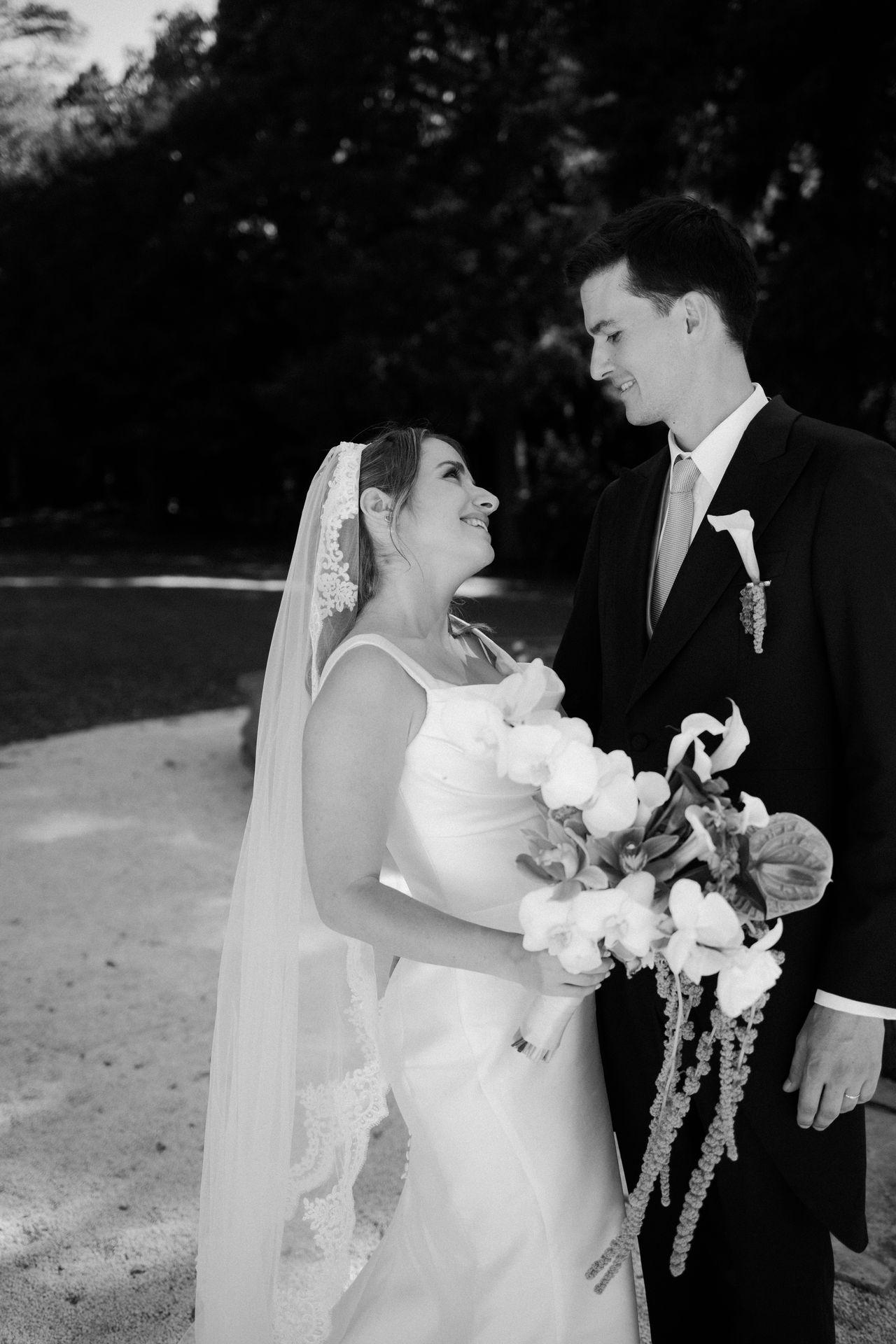
An image from the evening can appear at the beginning of the film and then take on another meaning when it reappears a few minutes later.
Two moments that were separated by several hours on the wedding day can thus respond to each other in the film.
It is these connections that allow for the construction of a narrative.
Editing no longer consists solely of deciding which image comes after another. It allows for the creation of links between moments that did not necessarily have them in the actual chronology of the day.
Sound allows for storytelling without needing to show everything.
This evolution is not only about images.
Sound plays an essential role.
A phrase from the vows can tell something about the couple while the image shows us something entirely different.
A few words spoken by a grandmother, a father, a sister, or a witness can give a new depth to images that we saw just a few seconds earlier.
And it’s not just speeches.
The applause of a ceremony. A breath. Conversations during a cocktail. The rustle of a dress. A door opening. Guests starting to sing. The sudden change in atmosphere when the evening begins.
All these sounds contribute to the narrative.
The film can thus tell several things simultaneously:
what we see, what we hear and what we understand about the relationship between the two.
This is also what allows a few minutes of film to be much richer than a simple succession of beautiful images accompanied by music.
Shorter does not necessarily mean faster.
This is an important distinction.
Reducing the duration of a film does not consist of multiplying shots or constantly speeding up the editing.
A wedding film of a few minutes is not meant to become a six-minute Reel.
It needs to breathe.
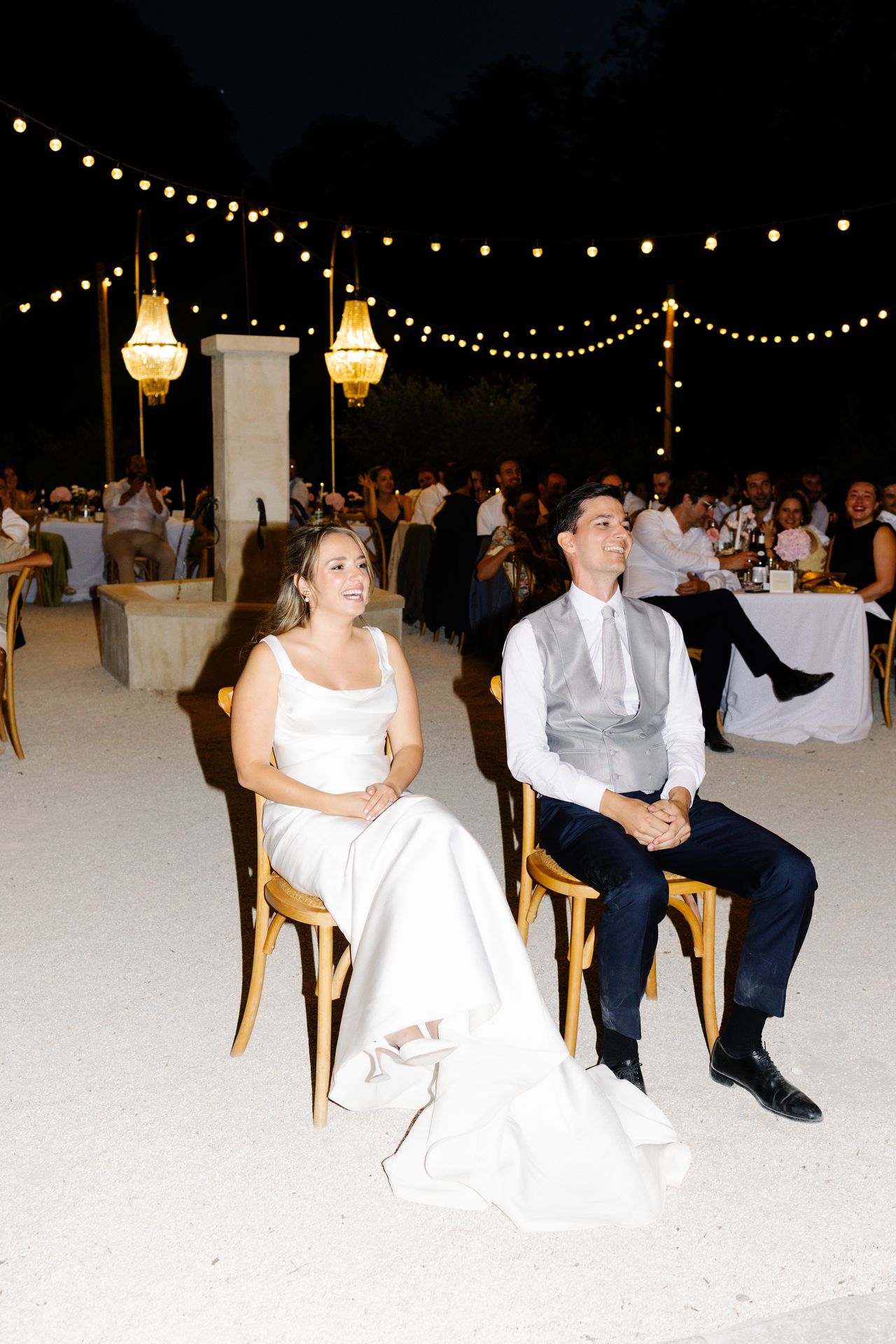
Some shots can last longer. A phrase may need to go all the way. A piece of music can fade out to leave a few seconds for the real sound. After a very energetic sequence, a glance or a silence can sometimes be much more powerful than a new succession of images.
Dynamism does not only come from speed. It also comes from contrasts.
Calm after energy.
Silence after music.
A shot that lasts after several very short shots.
An intimate moment after a collective sequence.
It is this variation that creates the rhythm and allows the film to remain fluid without becoming frantic.
Being More Selective Also Helps Give the Film Its Own Identity
A wedding day produces an enormous amount of material.
Hundreds of situations. Glances. Conversations. Gestures. Details. Reactions.
Not everything can have the same importance in the film.
Editing also involves identifying what truly characterises this wedding.
For one, it may be the relationship with the families.
For another, the incredible energy of friends.
Elsewhere, it will be the speeches, a particularly strong ceremony, a lot of humour or on the contrary something very intimate.
Shortening requires making choices.
And these choices can indeed allow the film to have a much more defined identity.
The goal is no longer necessarily to be able to tick off each step of the day.
It is to be able to watch the film and say to oneself:
« It really felt like us.»
A Short Wedding Film Can Be Much More Than a Summary
A summary generally seeks to condense a day.
A narrative film seeks more to interpret it.
The difference may seem subtle, but it changes a lot in the editing.
If I am only looking to summarise, I mainly need to answer the question:
What happened?
If I am looking to construct a film, other questions arise:
What characterised this wedding?
What relationships were particularly important?
What words give meaning to the images?
Where should one slow down?
At what point should one instead create energy?
What image deserves to come back?
What can be left out because the viewer has already understood it?
It is at this point that duration ceases to be merely a technical constraint to become a writing choice.
The Way We Watch Films Has Evolved Too
We are now accustomed to understanding the language of images very quickly.
In a film, a series, a documentary, or an advertisement, no one needs to see a character get into their car, start it, travel thirty kilometres, park, and then enter a house to understand that they have moved.
A starting image and then an arrival image are sufficient.
The viewer naturally reconstructs what happened in between.
A wedding film can use exactly the same principles.
It is not necessary to show every transition in full to understand the flow of a day.
This leaves more room for the moments that truly add something to the narrative.
Why 5 to 7 Minutes Can Actually Capture So Much
In my work, my short films today generally last around 5 to 7 minutes.
This duration has gradually established itself with my storytelling style, my editing experience, and the feedback from my couples.
It allows me to maintain what I seek in a film: creativity, rhythm, pauses, a smooth narrative, and enough density to want to watch it again and again.
But these few minutes are the result of an entire day's worth of material.
The film can contain footage of the preparations, the ceremony, the cocktail, couple moments, the dinner, and the evening without dedicating a complete and chronological sequence to each of these stages.
It selects what it needs to tell the story.
And this is an important difference:
the duration of the film does not correspond to the amount of filmed material. It corresponds to how that material is used.
What If You Want to Relive More of Your Wedding Day?
It is another expectation, equally legitimate.
Some couples wish to have, in addition, a more chronological film that allows more space for the different moments of the wedding.
Others want to keep a ceremony or certain speeches in a much more complete manner.
In this case, a long film or specific recordings better meet this desire for memory.
But it is no longer exactly the same function.
I’ve dedicated an entire article to exploring the differences between these formats and how to choose the one that best reflects what you want to preserve from your wedding day.
Perhaps the Real Question Isn’t: How Long Is the Film?
When you discover the work of a wedding videographer, the duration is obviously useful information.
But it does not say how those minutes are used.
A 6-minute film may seem too short on a brochure and perfectly right when watched.
A longer film can allow for many more moments to be captured if that is what one is looking for.
The interesting question then perhaps becomes less:
"How many minutes will I receive?"
than:
"What does the film manage to convey during those minutes?"
Because a wedding film does not necessarily need to show everything to allow us to relive a day.
Sometimes, a few images, a voice, a silence, and a glance are enough to bring back much more than what we actually see on screen.