
« We are not very comfortable in front of photos. »
« We are afraid of being awkward in front of the camera. »
« We mainly want something natural. »
These are probably three of the phrases I hear most often when I meet future brides and grooms.
And they ultimately speak of the same concern: the fear that the presence of a camera will change the way you experience your wedding.
However, it is not necessary to be comfortable in front of a camera to have a natural wedding film. And for the vast majority of the day, you don’t even have anything particular to do.
You are getting married to experience your wedding, not to spend your day creating images of your wedding.
Being filmed during your wedding is not the same as posing in front of a camera.
There is an important difference between being filmed and having to perform for the camera.
During the preparations, a ceremony, a cocktail or a dinner, my job mainly consists of observing what is happening and finding my place to film it.
A glance exchanged during the preparations. A hand resting on a shoulder. A reaction during a speech. A laugh in the middle of the cocktail. A few seconds of silence just before a ceremony.
These moments already exist.
I do not need to provoke them in order to film them.
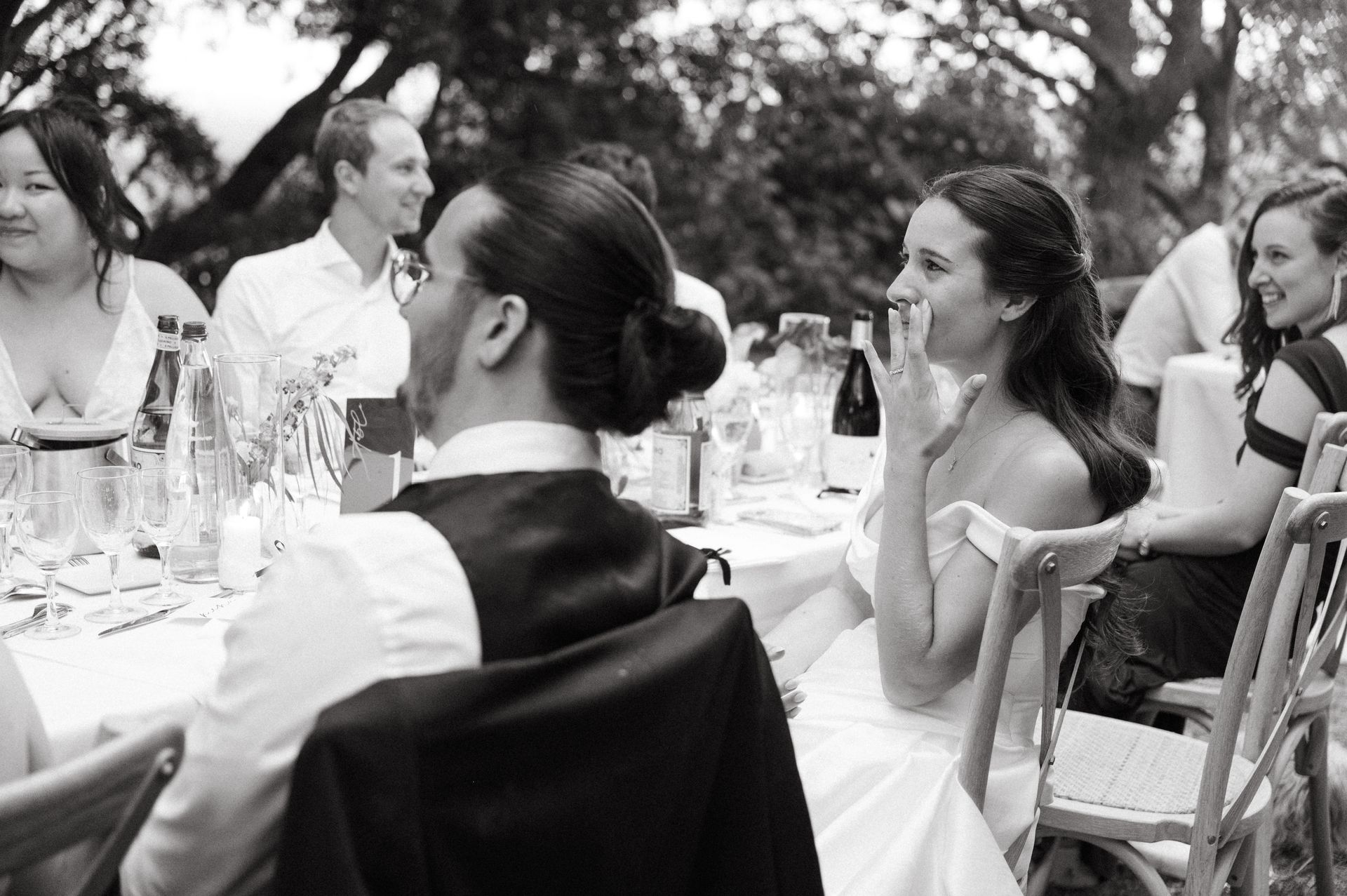
That’s also why people who tell me they feel very uncomfortable in front of a camera are often surprised when they see their film.
They sometimes don’t even remember certain shots.
Is the videographer going to ask us to redo certain things?
In my way of working, very rarely.
I’m not going to ask you to redo an entrance into a room because I wasn’t in the right place, to redo an exchange with your loved ones, or to recreate an emotion that just happened.
If a moment has passed, it has passed.
This obviously requires anticipating more: understanding what is going to happen, observing people, quickly choosing a frame, and sometimes accepting that a real moment may not be technically perfect.
But it is precisely this reality that gives value to the images.
A wedding is not a shoot.
And the couple session?
This is generally the moment that worries couples the most who don’t like being filmed.
Because, for once, you know that the photographer and the videographer are there for you.
However, a couple session doesn’t need to become a succession of poses.
I can give a few very simple indications: suggesting you walk, move towards more interesting light, or place yourselves in a spot that works better visually.
But the goal is not to make you act out something that doesn’t resemble you.
It’s more about creating the right conditions and then letting something happen between you..
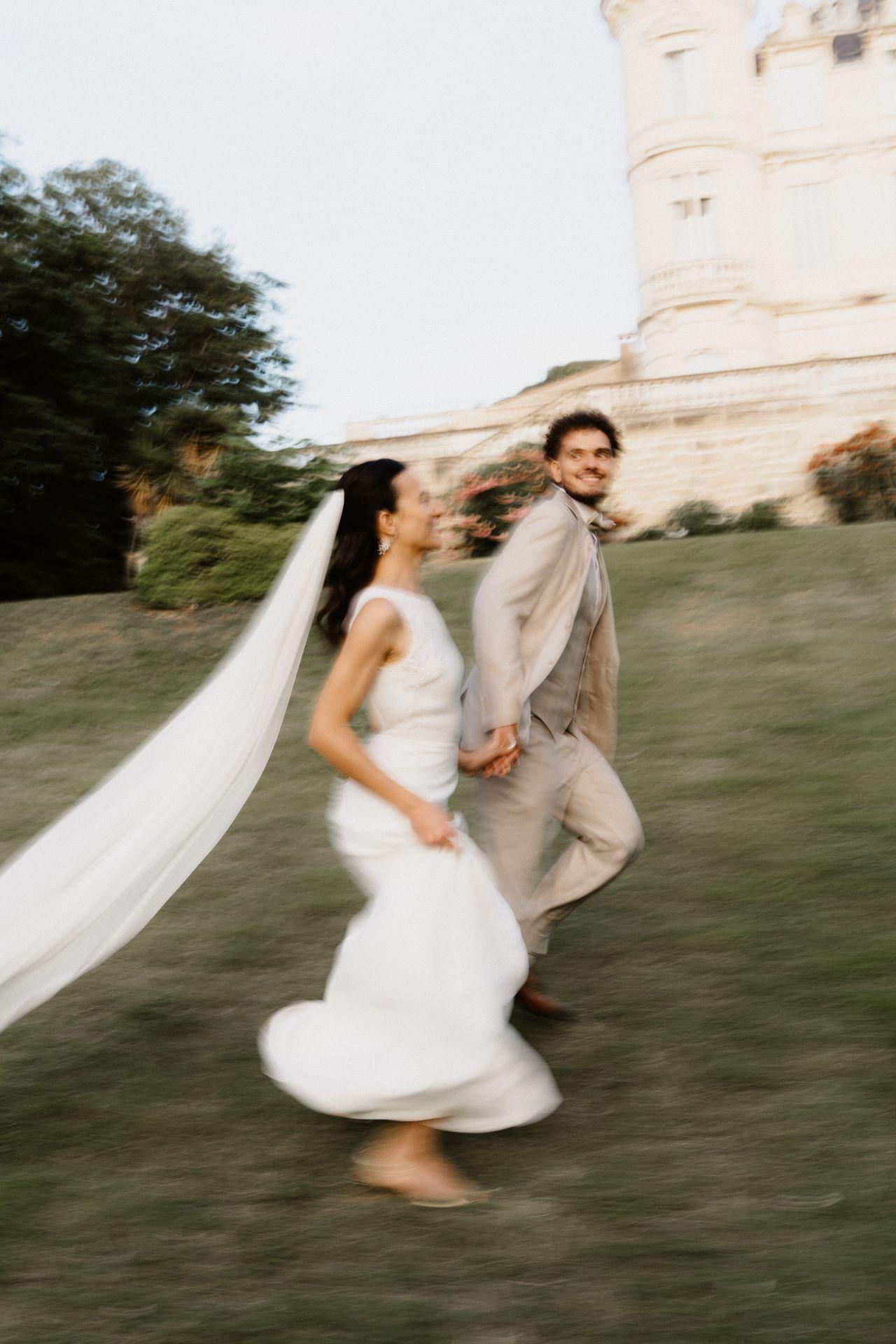
And above all, this session should not take over your day.
You are getting married to experience your wedding, not to spend hours creating images of your wedding.
"As soon as I see a camera, I tense up"
It’s normal to think that you will notice the camera all day.
In reality, the opposite usually happens.
At the beginning of the preparations, you may be more aware of my presence. Then the day really begins: loved ones arrive, emotions rise, it’s time to leave for the ceremony, the guests are here…
And the camera gradually stops being the focus of your attention.
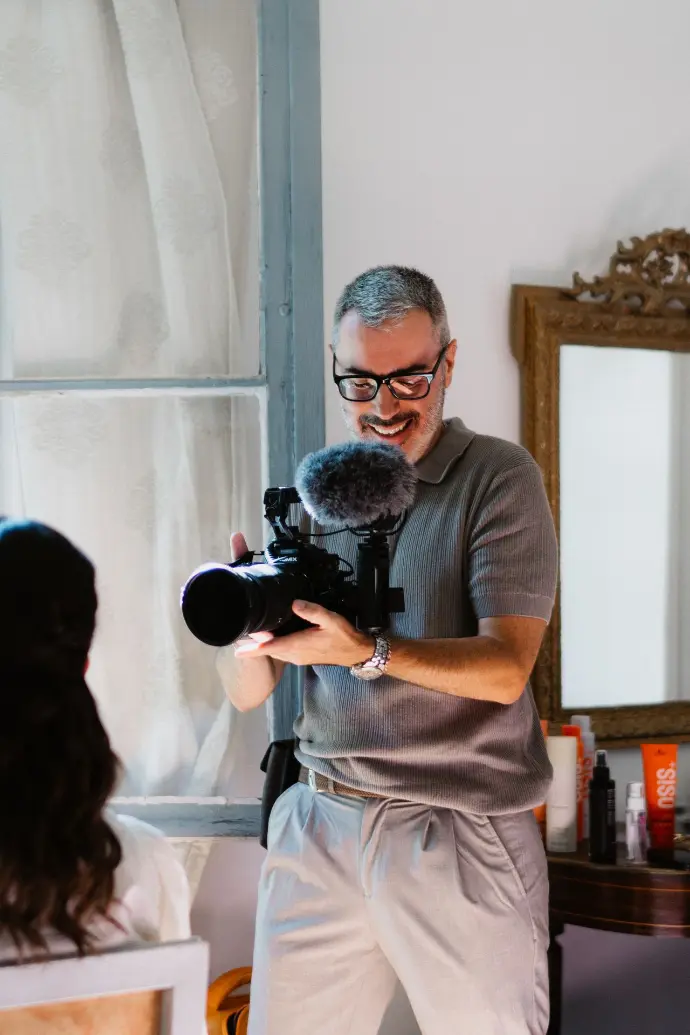
How to have a natural wedding film?
A natural wedding film doesn’t really depend on your ability to forget that a camera is present. It mainly depends on how the videographer works around you.
To get spontaneous images, the principle is quite simple: let you live the moments rather than create them for the camera.
This means not interrupting a conversation because the light would be better a few metres away. Not asking you to redo an entrance into a room. Not artificially provoking an emotion or gesture just because it would look good on camera.
My job is more about anticipating. Choosing my position, my focal length, my frame and my distance so that I can film what is happening without needing to modify it.
There are obviously moments when I can give a very simple indication, particularly during the couple session. But even at that moment, the goal is not to make you act out a scene. A light direction can simply create the conditions in which something natural will occur: walking, talking together, getting closer, enjoying a few minutes of being together.
Naturalness does not come from the absence of work around the image. It comes from the fact that this work does not force you to step out of what you are experiencing.
This is also why it is not necessary to be particularly comfortable in front of a camera. You do not have to produce the images. It is up to the videographer to know how to find them.
There is also a difference between filming someone a few dozen centimetres from their face and working with enough distance to give them their space.
The choice of frame and lens allows you to seek an emotion without necessarily entering the bubble of the person experiencing it.
A natural film does not mean a film left to chance.
This is an important nuance.
Not interrupting what is happening does not simply mean turning on a camera and waiting.
To obtain natural and aesthetic images, you must, on the contrary, anticipate a lot.
Where is the action likely to occur?
Where is the light coming from?
What background will work?
Who is important in this moment?
What focal length allows you to stay close enough without intervening?
Should we stay or move before something begins?
A large part of the work happens a few seconds before the image you will ultimately see in the film.
This is what allows for constructed frames, a coherent image, and a worked colour grading, without turning lived moments into staged scenes for the video.
You don’t need to "know what to do"
This is probably the most important point.
You don’t have to think about the film during your wedding.
You don’t have to regularly ask yourself where the camera is, if you are well positioned, or if a moment deserves to be filmed.
That’s my job.
Yours is much simpler: live what is happening.
And paradoxically, it is often when you completely stop thinking about the images that the most interesting ones appear.
What makes a film natural is not just the images
There are also the voices.
A wedding film does not only tell a day with a succession of beautiful shots.
A phrase spoken during a ceremony. A few words from a parent. A laugh. A hesitation in a voice. The noise of guests a few seconds before an entrance.
The real sound allows for something that images alone cannot always convey.
This is also why I place great importance on recording ceremonies, speeches, and atmospheres.
[INTERNAL LINK — on "real sound" or "the voices" → article: What sound reveals in a wedding film]
And what if we are really very reserved?
Then you simply need to discuss it with your videographer before the wedding.
Not to plan for more staging. On the contrary.
Knowing that a couple is particularly reserved allows for adapting one's presence, the duration of a couple's session, or the way to give some indications when necessary.
There is not just one good way to film all couples.
Some are very demonstrative. Others much less so. Some talk a lot. Others express things more through their gestures or looks.
A film must be able to respect that.
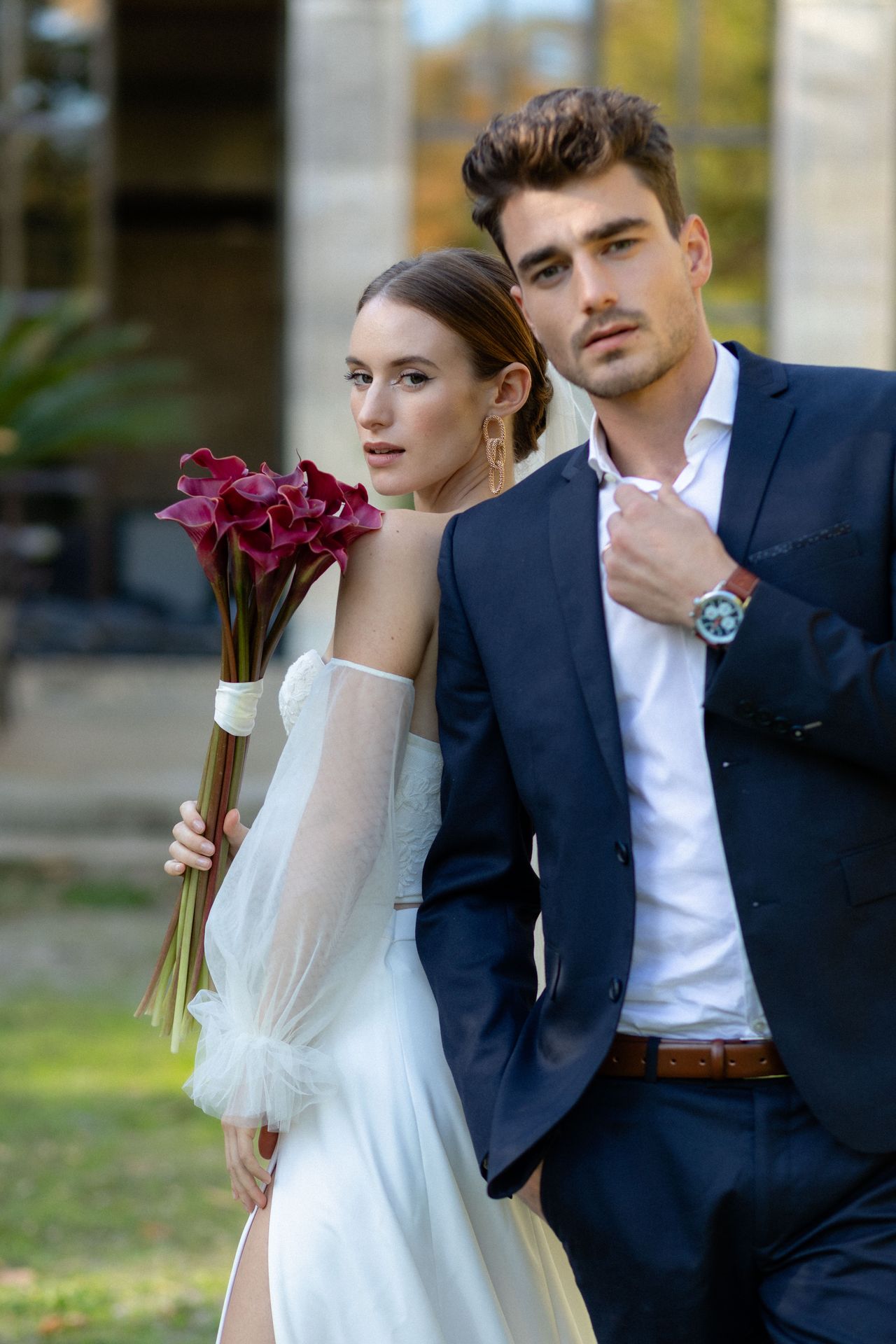
This also explains why two films made by the same videographer can have a different identity.
Why your wedding film will not look exactly like the films you have seen on my site.
So, should you hire a videographer if you don't like being filmed?
Yes, provided you choose a filming style that suits you.
If the idea of spending your wedding posing displeases you, the question may not be whether you are "made for video".
The real question is rather:
how do you want your wedding to be filmed?
Watch the complete films of the videographer you are considering. Observe the couples. Do the people seem aware of the camera? Do the situations seem staged? Do the gestures seem natural to you? Can you imagine experiencing your day in this way?
And talk about it with him.
A wedding film should not ask you to become someone else for a day to get beautiful images.
For my part, I prefer to start from what already exists: the looks, the gestures, the voices, the silences and everything that happens when you are no longer thinking about the camera.
It is from this material that the film is constructed.