
A smooth wedding on the day is rarely the result of chance.
Behind a ceremony that starts at the right moment, a cocktail that flows naturally, or a dinner that follows seamlessly without making the couple feel like they are chasing their schedule, there are often weeks or months of preparation.
And when a wedding planner accompanies the couple, their role goes far beyond the coordination of the day.
They know the project as a whole.
The couple.
The venue.
The suppliers.
The schedule.
The constraints.
And especially the experience that the couple wishes to provide for their guests.
As a videographer, this overall vision is particularly valuable to me.
But good collaboration works both ways.
My role is also to integrate into this organisation without complicating it, to anticipate my own needs, and to work with the other suppliers so that the couple can, as much as possible, forget all the mechanics that exist behind their day.
Working well together starts before the wedding.
The collaboration between the wedding planner and the videographer should not start on the morning of the wedding.
In advance, a few pieces of information can already change a lot of things.
The projected schedule for the day.
The different spaces used.
The specifics of a ceremony.
The surprises possibly prepared by loved ones.
The planned interventions during dinner.
The specific constraints of the venue.
This allows me to anticipate.
Not to freeze the day in a parallel video schedule, but precisely to avoid having to intervene unnecessarily once it has started.
On my side, I also try to limit requests.
If I need technical information or a specific time, I prefer to check it in advance rather than ask the wedding planner when she is already managing ten other topics on the day.
Good coordination is often that which the couple never sees.
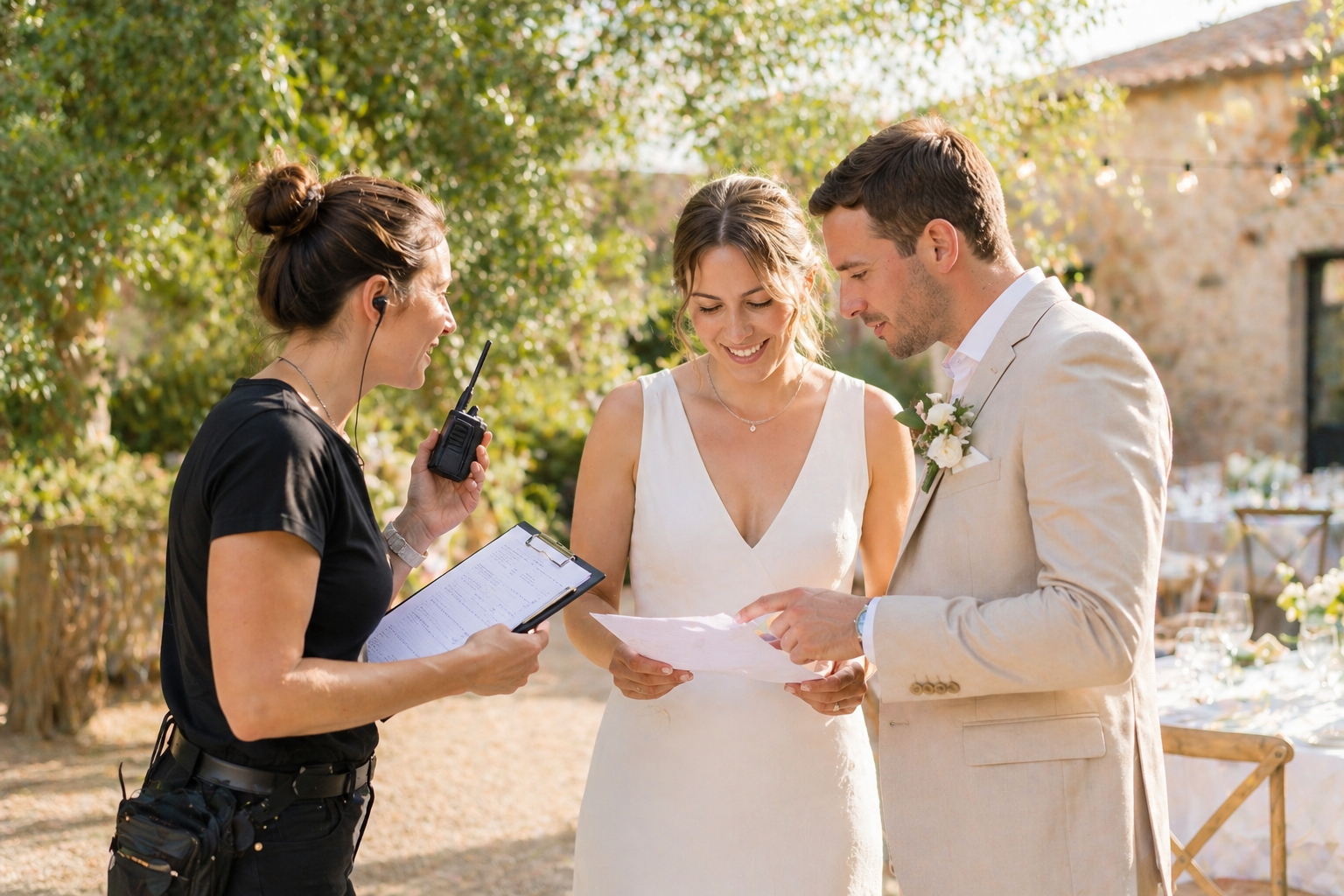
On the day, respect the work that has been built in advance.
A wedding planner sometimes works for over a year on a wedding.
It seems essential to me, when I arrive with my cameras, to understand that I am integrating into an experience that has already been thought out.
My film must not become an additional constraint.
I am not looking to modify a sequence simply to get a shot.
I do not ask to shift a moment without a significant reason.
And I do not consider that the needs of the video should take precedence over those of the couple, the photographer, the caterer, the DJ, or the overall organisation.
This obviously does not mean remaining passive.
It can be useful to point out that a light will be particularly beautiful twenty minutes later, that a speech requires special anticipation for the sound, or that a setup may make capturing more difficult.
But the idea is then to propose and communicate, not to impose.
It is this relationship that allows everyone to do their job properly without the couple having to arbitrate between their suppliers.
Wedding planner, photographer and videographer: creating a common workflow.
The relationship with the photographer is obviously central to my work.
We often need to be in the same place at the same time.
During the preparations.
A ceremony.
A couple's session.
An entrance.
A first dance.
Coordination therefore does not involve determining who will have priority.
It involves finding a way to work together quickly enough.
The same goes for the wedding planner.
If she knows how I operate and I understand her constraints, many things can be resolved in a few seconds, sometimes simply with a glance.
And when this trust exists between the different suppliers, it has a very concrete consequence:
the couple never becomes the coordinators of their own team.
They can simply enjoy their wedding.
Anticipate without rigidifying.
A precise schedule is essential.
But a wedding remains a living day.
A preparation can be fifteen minutes late.
A cocktail can be so enjoyable that no one wants to leave it immediately.
An intervention planned during dinner may ultimately start later.
The weather can force changes to a space at the last moment.
The role of a wedding planner is precisely to manage part of these adjustments.
For me, the challenge is to know how to adapt without adding a new constraint.
A wedding film also thrives on what was not planned.
One must be sufficiently prepared to know where one is going, but also sufficiently available to observe what is actually happening.
The couple's session should not overshadow the wedding.
This is a point where good coordination between the wedding planner, photographer, and videographer can truly enhance the experience for the couple.
The couple's session is important.
It allows for the creation of certain images in a calmer environment and often to take advantage of interesting light at the end of the day.
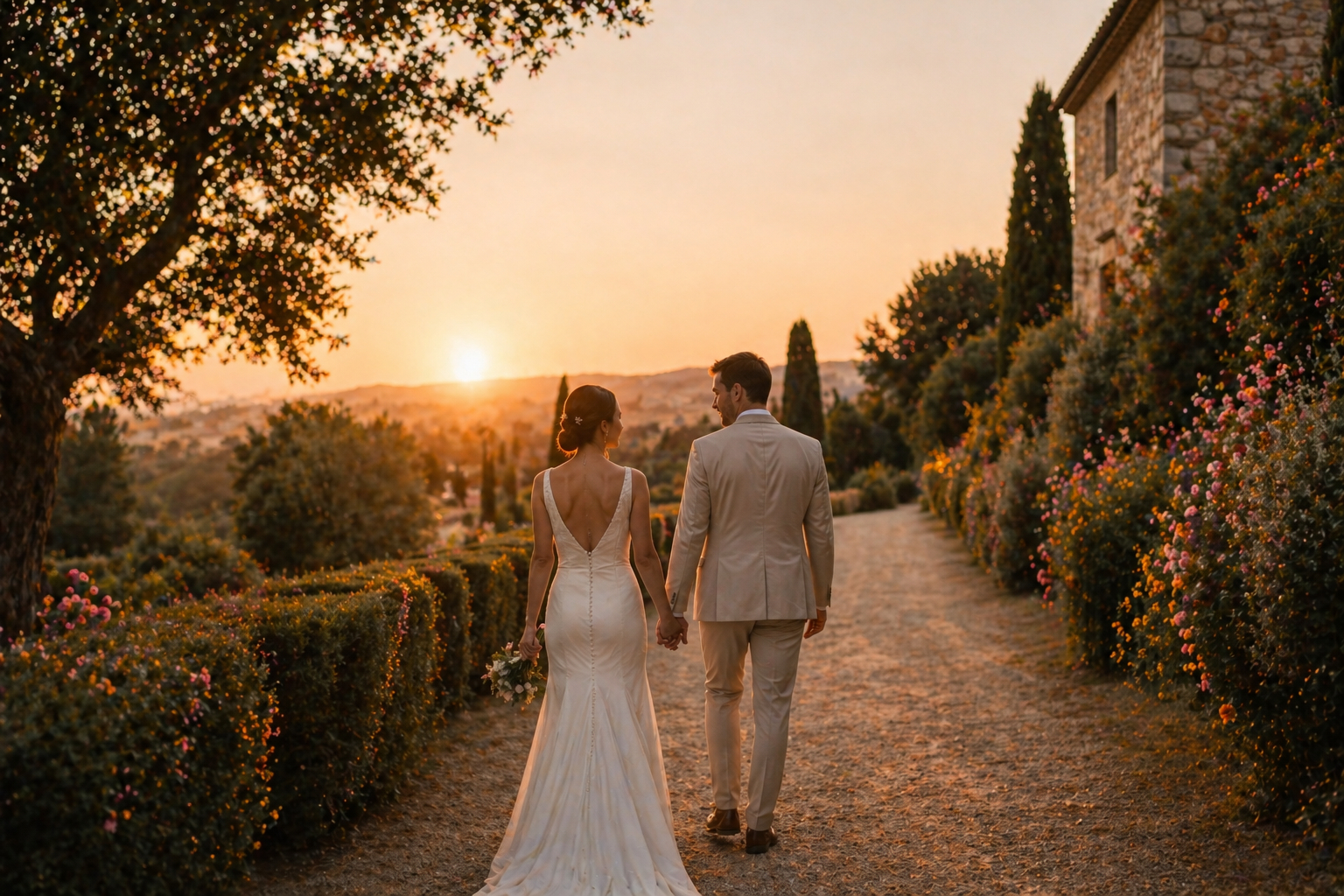
But I don't think it should become an endless interlude during which the couple disappears from their own cocktail.
I generally prefer a well-prepared moment, intelligently integrated into the schedule and coordinated with the photographer.
In some weddings, the wedding planner also allows a few minutes of genuine breathing space for the couple.
Not for the photo.
Not for the video.
Simply for them.
And this distinction is important.
Not all beautiful moments of a wedding need to be turned into content.
Sometimes, our role as a service provider also involves knowing how to leave a quiet space.
What the videographer can bring to the wedding planner.
Collaboration is not just about receiving a perfectly organised schedule.
As a videographer, I also have a responsibility for the smoothness of the day.
This starts with autonomy.
Arriving prepared.
Knowing the information provided.
Anticipating my equipment.
Preparing for sound capture.
Identifying the people who will be involved early enough.
And avoiding, as much as possible, last-minute requests that could have been resolved beforehand.
This also involves communication.
If a difficulty arises, my first instinct is not to make it a problem for the couple.
I first look for a solution with the relevant professionals.
And when something needs to be adjusted, a few simple exchanges between providers are generally preferable to a multiplication of requests to the couple.
For a wedding planner, being able to rely on autonomous providers means less micromanagement on the day.
And it is also, in my opinion, what a team used to working on demanding weddings should bring.
Also respecting the aesthetic vision of the wedding.
A wedding planner does not just coordinate schedules.
Depending on the projects, she may also have participated for months in building a universe with the couple, the scenography, the floral designer, the venue, and all the creative providers.
In video, this dimension deserves to be understood.
It is not just about filming the couple.
It is also necessary to tell the story of the venue as it was envisioned.
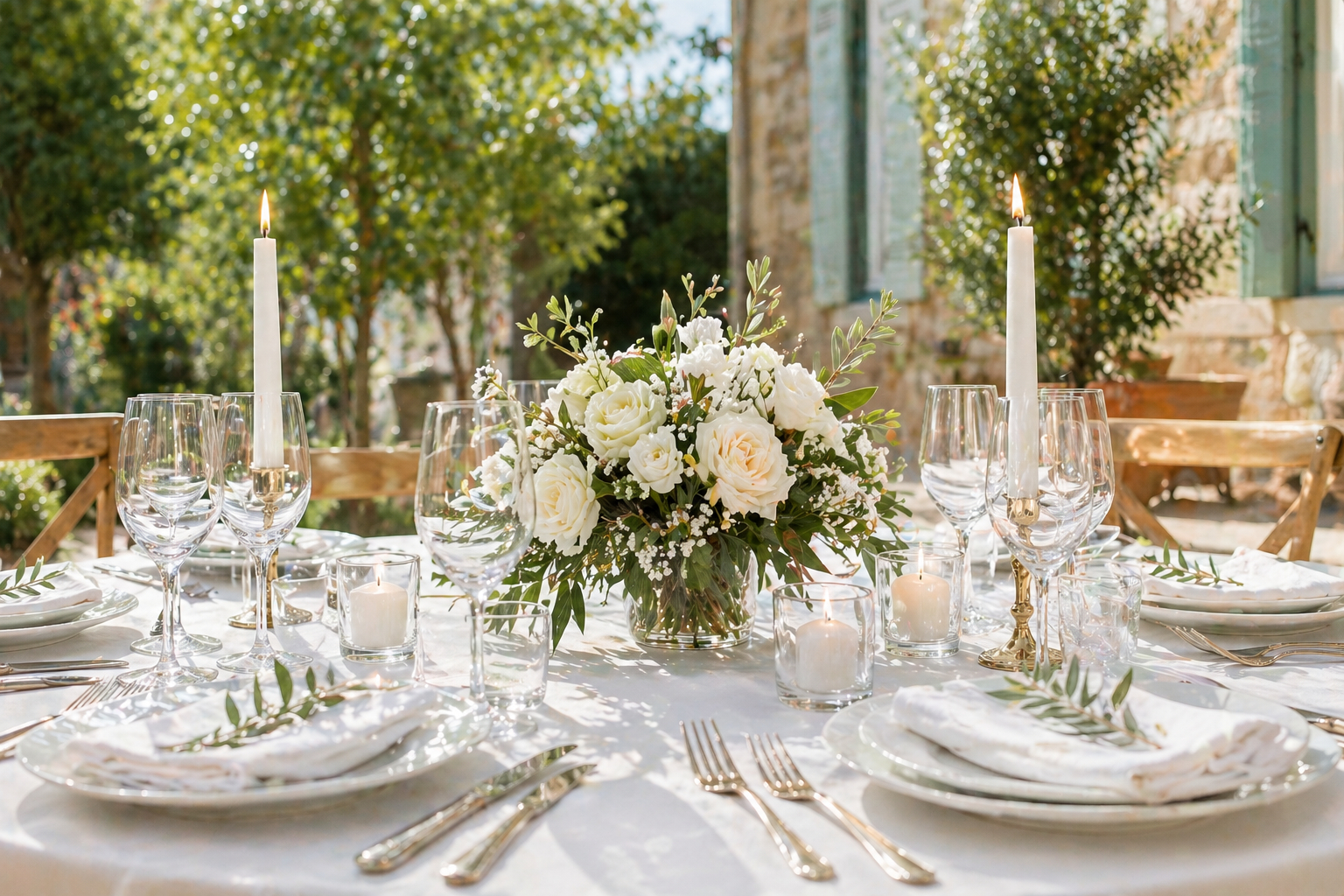
The table before the guests are seated.
The details of the scenography.
The flowers.
The light.
The overall atmosphere.
Then the way in which all these spaces will gradually be inhabited.
These are obviously important images for the couple's film.
But they also allow for a record of the work done by the entire team.
[IMAGE — Scenography and decoration of a wedding organised by a wedding planner]
A collaboration that continues after the wedding.
The relationship between providers does not necessarily stop when the dancefloor begins.
After the wedding, I like to be able to share the film with the professionals who participated in the project.
The wedding planner accompanied the couple for months.
She knows the intentions behind certain choices and all the work necessary to achieve the final result.
Watching the film also allows for discovering the day from another perspective.
And when a project can be shared, the film naturally becomes a means of showcasing the collective work: wedding planner, venue, photographer, floral designer, creators, caterer, DJ, and all those who contributed to the wedding.
I want to identify and credit the relevant professionals when their work appears in my publications.
Because a wedding is never the work of a single provider.
What this collaboration changes for the couple.
Ultimately, all this coordination has a fairly simple objective.
That the couple does not have to deal with it.
They should not have to wonder if the photographer and the videographer have agreed on the timing of the couple's session.
Nor if the videographer knows the time of the speeches.
Nor if the DJ knows that an audio recording is necessary.
Nor who should inform the caterer that a moment has taken a few minutes longer.
When the team truly functions as a team, these questions remain among professionals.
And the couple can focus their attention on what they are there for: their loved ones and their wedding.
It is this fluidity that I seek when I work with a wedding planner.
Not a perfectly controlled day.
A day well enough prepared to allow for what cannot be planned.
Wedding planner and videographer: two different roles, one experience to preserve.
The wedding planner and the videographer obviously do not have the same job.
She thinks, organizes, coordinates, and supports.
On my side, I observe, I film, and then I build the narrative of what has been experienced.
But our two professions converge on one important point: the experience of the couple should never be sacrificed for the functioning of the suppliers.
The simpler, more anticipated, and respectful the collaboration is of everyone's role, the less visible it becomes on the big day.
And that is probably the best sign that it is working.
If you are a wedding planner and wish to discover my way of working, or if you are preparing your wedding with a professional who is accompanying you, you can discover:
→ My approach to wedding films